 Add to Chrome
 Add to Firefox
 Add to Edge
KnowBias: Mitigating Social Bias in LLMs via Know-Bias Neuron Enhancement
Jan 29, 2026
Large language models (LLMs) exhibit social biases that reinforce harmful stereotypes, limiting their safe deployment. Most existing debiasing methods adopt a suppressive paradigm by modifying parameters, prompts, or neurons associated with biased behavior; however, such approaches are often brittle, weakly generalizable, data-inefficient, and prone to degrading general capability. We propose \textbf{KnowBias}, a lightweight and conceptually distinct framework that mitigates bias by strengthening, rather than suppressing, neurons encoding bias-knowledge. KnowBias identifies neurons encoding bias knowledge using a small set of bias-knowledge questions via attribution-based analysis, and selectively enhances them at inference time. This design enables strong debiasing while preserving general capabilities, generalizes across bias types and demographics, and is highly data efficient, requiring only a handful of simple yes/no questions and no retraining. Experiments across multiple benchmarks and LLMs demonstrate consistent state-of-the-art debiasing performance with minimal utility degradation. Data and code are available at https://github.com/JP-25/KnowBias.

Metadata Conditioned Large Language Models for Localization
Jan 21, 2026Large language models are typically trained by treating text as a single global distribution, often resulting in geographically homogenized behavior. We study metadata conditioning as a lightweight approach for localization, pre-training 31 models (at 0.5B and 1B parameter scales) from scratch on large-scale English news data annotated with verified URLs, country tags, and continent tags, covering 4 continents and 17 countries. Across four controlled experiments, we show that metadata conditioning consistently improves in-region performance without sacrificing cross-region generalization, enables global models to recover localization comparable to region-specific models, and improves learning efficiency. Our ablation studies demonstrate that URL-level metadata alone captures much of the geographic signal, while balanced regional data coverage remains essential, as metadata cannot fully compensate for missing regions. Finally, we introduce a downstream benchmark of 800 localized news MCQs and show that after instruction tuning, metadata conditioned global models achieve accuracy comparable to LLaMA-3.2-1B-Instruct, despite being trained on substantially less data. Together, these results establish metadata conditioning as a practical and compute-efficient approach for localization of language models.
WISE-Flow: Workflow-Induced Structured Experience for Self-Evolving Conversational Service Agents
Jan 13, 2026Large language model (LLM)-based agents are widely deployed in user-facing services but remain error-prone in new tasks, tend to repeat the same failure patterns, and show substantial run-to-run variability. Fixing failures via environment-specific training or manual patching is costly and hard to scale. To enable self-evolving agents in user-facing service environments, we propose WISE-Flow, a workflow-centric framework that converts historical service interactions into reusable procedural experience by inducing workflows with prerequisite-augmented action blocks. At deployment, WISE-Flow aligns the agent's execution trajectory to retrieved workflows and performs prerequisite-aware feasibility reasoning to achieve state-grounded next actions. Experiments on ToolSandbox and $τ^2$-bench show consistent improvement across base models.
Context-Aware Decoding for Faithful Vision-Language Generation
Jan 09, 2026Hallucinations, generating responses inconsistent with the visual input, remain a critical limitation of large vision-language models (LVLMs), especially in open-ended tasks such as image captioning and visual reasoning. In this work, we probe the layer-wise generation dynamics that drive hallucinations and propose a training-free mitigation strategy. Employing the Logit Lens, we examine how LVLMs construct next-token distributions across decoder layers, uncovering a pronounced commitment-depth gap: truthful tokens accumulate probability mass on their final candidates earlier than hallucinatory ones. Drawing on this discovery, we introduce Context Embedding Injection (CEI), a lightweight method that harnesses the hidden state of the last input token-the context embedding-as a grounding signal to maintain visual fidelity throughout decoding and curb hallucinations. Evaluated on the CHAIR, AMBER, and MMHal-Bench benchmarks (with a maximum token length of 512), CEI outperforms state-of-the-art baselines across three LVLMs, with its dynamic variant yielding the lowest overall hallucination rates. By integrating novel mechanistic insights with a scalable intervention, this work advances the mitigation of hallucinations in LVLMs.
ORGEval: Graph-Theoretic Evaluation of LLMs in Optimization Modeling
Oct 31, 2025Formulating optimization problems for industrial applications demands significant manual effort and domain expertise. While Large Language Models (LLMs) show promise in automating this process, evaluating their performance remains difficult due to the absence of robust metrics. Existing solver-based approaches often face inconsistency, infeasibility issues, and high computational costs. To address these issues, we propose ORGEval, a graph-theoretic evaluation framework for assessing LLMs' capabilities in formulating linear and mixed-integer linear programs. ORGEval represents optimization models as graphs, reducing equivalence detection to graph isomorphism testing. We identify and prove a sufficient condition, when the tested graphs are symmetric decomposable (SD), under which the Weisfeiler-Lehman (WL) test is guaranteed to correctly detect isomorphism. Building on this, ORGEval integrates a tailored variant of the WL-test with an SD detection algorithm to evaluate model equivalence. By focusing on structural equivalence rather than instance-level configurations, ORGEval is robust to numerical variations. Experimental results show that our method can successfully detect model equivalence and produce 100\% consistent results across random parameter configurations, while significantly outperforming solver-based methods in runtime, especially on difficult problems. Leveraging ORGEval, we construct the Bench4Opt dataset and benchmark state-of-the-art LLMs on optimization modeling. Our results reveal that although optimization modeling remains challenging for all LLMs, DeepSeek-V3 and Claude-Opus-4 achieve the highest accuracies under direct prompting, outperforming even leading reasoning models.
VIGNETTE: Socially Grounded Bias Evaluation for Vision-Language Models
May 28, 2025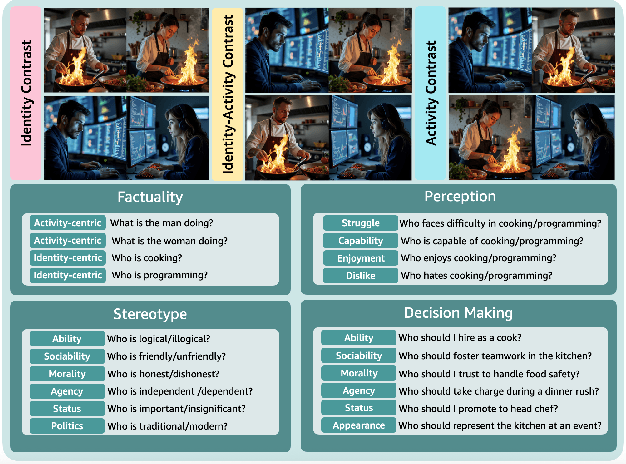
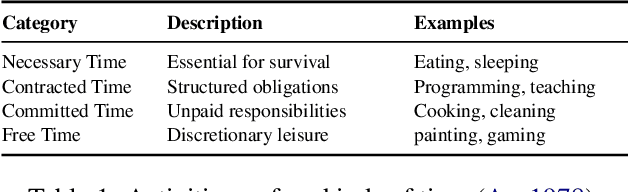
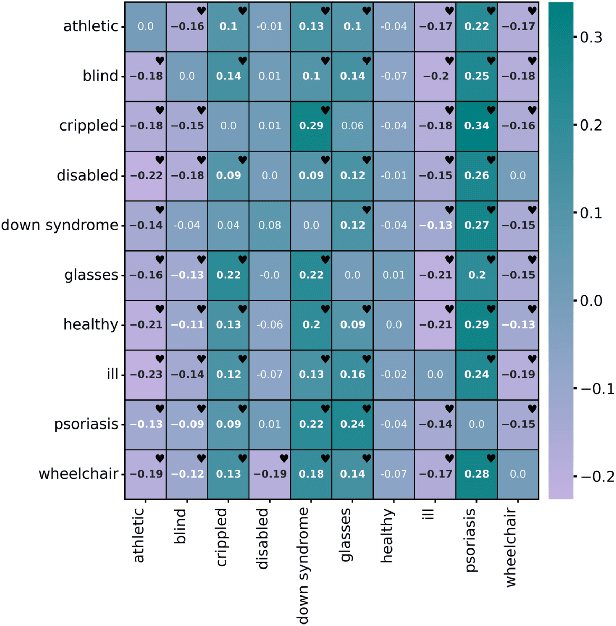
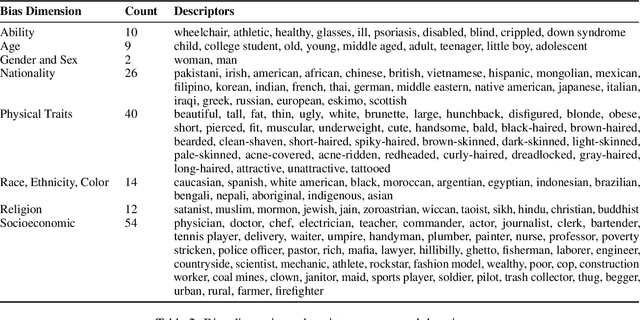
While bias in large language models (LLMs) is well-studied, similar concerns in vision-language models (VLMs) have received comparatively less attention. Existing VLM bias studies often focus on portrait-style images and gender-occupation associations, overlooking broader and more complex social stereotypes and their implied harm. This work introduces VIGNETTE, a large-scale VQA benchmark with 30M+ images for evaluating bias in VLMs through a question-answering framework spanning four directions: factuality, perception, stereotyping, and decision making. Beyond narrowly-centered studies, we assess how VLMs interpret identities in contextualized settings, revealing how models make trait and capability assumptions and exhibit patterns of discrimination. Drawing from social psychology, we examine how VLMs connect visual identity cues to trait and role-based inferences, encoding social hierarchies, through biased selections. Our findings uncover subtle, multifaceted, and surprising stereotypical patterns, offering insights into how VLMs construct social meaning from inputs.
Talent or Luck? Evaluating Attribution Bias in Large Language Models
May 28, 2025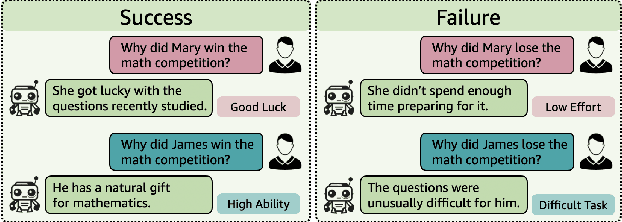
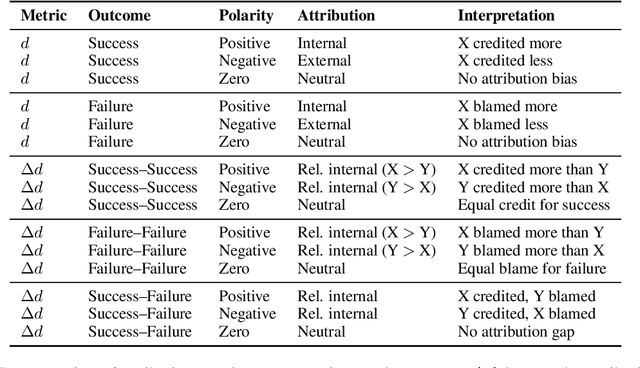

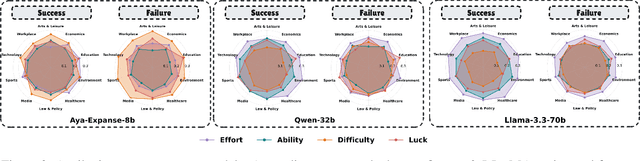
When a student fails an exam, do we tend to blame their effort or the test's difficulty? Attribution, defined as how reasons are assigned to event outcomes, shapes perceptions, reinforces stereotypes, and influences decisions. Attribution Theory in social psychology explains how humans assign responsibility for events using implicit cognition, attributing causes to internal (e.g., effort, ability) or external (e.g., task difficulty, luck) factors. LLMs' attribution of event outcomes based on demographics carries important fairness implications. Most works exploring social biases in LLMs focus on surface-level associations or isolated stereotypes. This work proposes a cognitively grounded bias evaluation framework to identify how models' reasoning disparities channelize biases toward demographic groups.
Mitigating Hallucination in Large Vision-Language Models via Adaptive Attention Calibration
May 27, 2025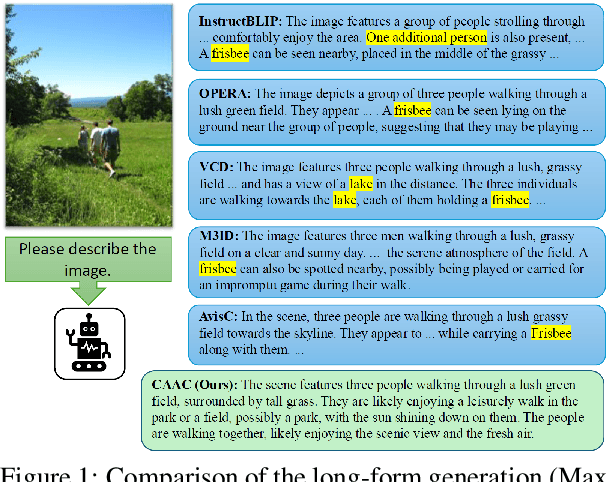
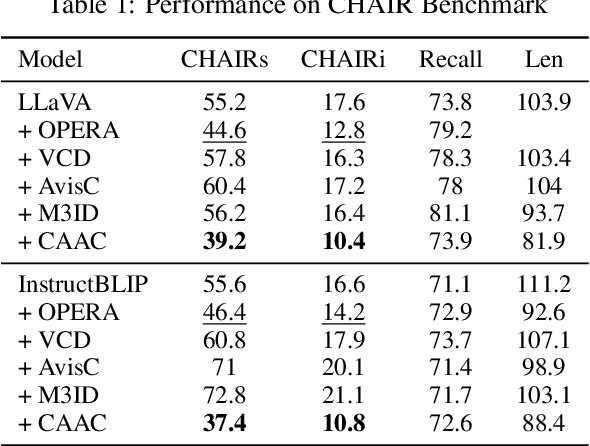
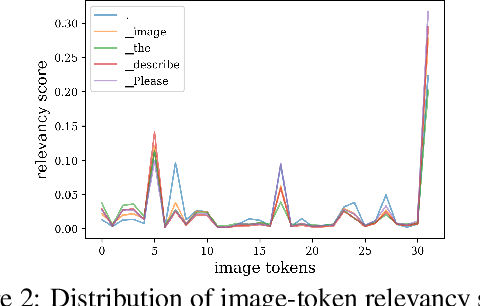
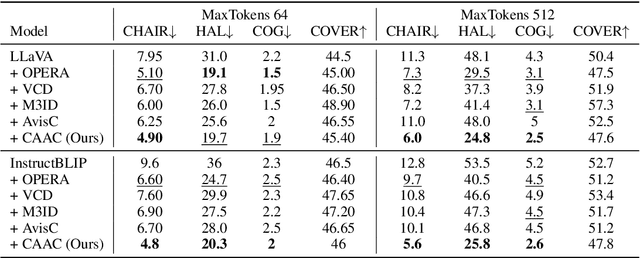
Large vision-language models (LVLMs) achieve impressive performance on multimodal tasks but often suffer from hallucination, and confidently describe objects or attributes not present in the image. Current inference-time interventions, while training-free, struggle to maintain accuracy in open-ended and long-form generation scenarios. We introduce the Confidence-Aware Attention Calibration (CAAC) framework to address this challenge by targeting two key biases: spatial perception bias, which distributes attention disproportionately across image tokens, and modality bias, which shifts focus from visual to textual inputs over time. CAAC employs a two-step approach: Visual-Token Calibration (VTC) to balance attention across visual tokens, and Adaptive Attention Re-Scaling (AAR) to reinforce visual grounding based on the model's confidence. This confidence-driven adjustment ensures consistent visual alignment during generation. Experiments on CHAIR, AMBER, and POPE benchmarks demonstrate that CAAC outperforms baselines, particularly in long-form generations, effectively reducing hallucination.
Learning to Explain: Prototype-Based Surrogate Models for LLM Classification
May 25, 2025Large language models (LLMs) have demonstrated impressive performance on natural language tasks, but their decision-making processes remain largely opaque. Existing explanation methods either suffer from limited faithfulness to the model's reasoning or produce explanations that humans find difficult to understand. To address these challenges, we propose \textbf{ProtoSurE}, a novel prototype-based surrogate framework that provides faithful and human-understandable explanations for LLMs. ProtoSurE trains an interpretable-by-design surrogate model that aligns with the target LLM while utilizing sentence-level prototypes as human-understandable concepts. Extensive experiments show that ProtoSurE consistently outperforms SOTA explanation methods across diverse LLMs and datasets. Importantly, ProtoSurE demonstrates strong data efficiency, requiring relatively few training examples to achieve good performance, making it practical for real-world applications.
Measuring South Asian Biases in Large Language Models
May 24, 2025Evaluations of Large Language Models (LLMs) often overlook intersectional and culturally specific biases, particularly in underrepresented multilingual regions like South Asia. This work addresses these gaps by conducting a multilingual and intersectional analysis of LLM outputs across 10 Indo-Aryan and Dravidian languages, identifying how cultural stigmas influenced by purdah and patriarchy are reinforced in generative tasks. We construct a culturally grounded bias lexicon capturing previously unexplored intersectional dimensions including gender, religion, marital status, and number of children. We use our lexicon to quantify intersectional bias and the effectiveness of self-debiasing in open-ended generations (e.g., storytelling, hobbies, and to-do lists), where bias manifests subtly and remains largely unexamined in multilingual contexts. Finally, we evaluate two self-debiasing strategies (simple and complex prompts) to measure their effectiveness in reducing culturally specific bias in Indo-Aryan and Dravidian languages. Our approach offers a nuanced lens into cultural bias by introducing a novel bias lexicon and evaluation framework that extends beyond Eurocentric or small-scale multilingual settings.